
Two purpose-built panels
Faculty and students browse, request, and monitor materials; administrators, committee members, IT staff, and custodians manage users, catalog data, access levels, and decisions.
Institutional software
A role-aware Laravel and Filament platform for managing an academic reading room's materials and access workflows.
Full-stack engineering, product workflows, testing, Render deployment, and shared-demo operations.
Laravel 12 · Filament 5 · PHP · PostgreSQL · Supabase Storage · Render
The brief
Academic reading-room workflows need more than a catalog: they need clear access rules, request history, and safe digital delivery.
Product experience
Faculty and students browse, request, and monitor materials; administrators, committee members, IT staff, and custodians manage users, catalog data, access levels, and decisions.
Physical borrowing and digital-access requests carry statuses, reasons, due dates, notifications, and an auditable history.
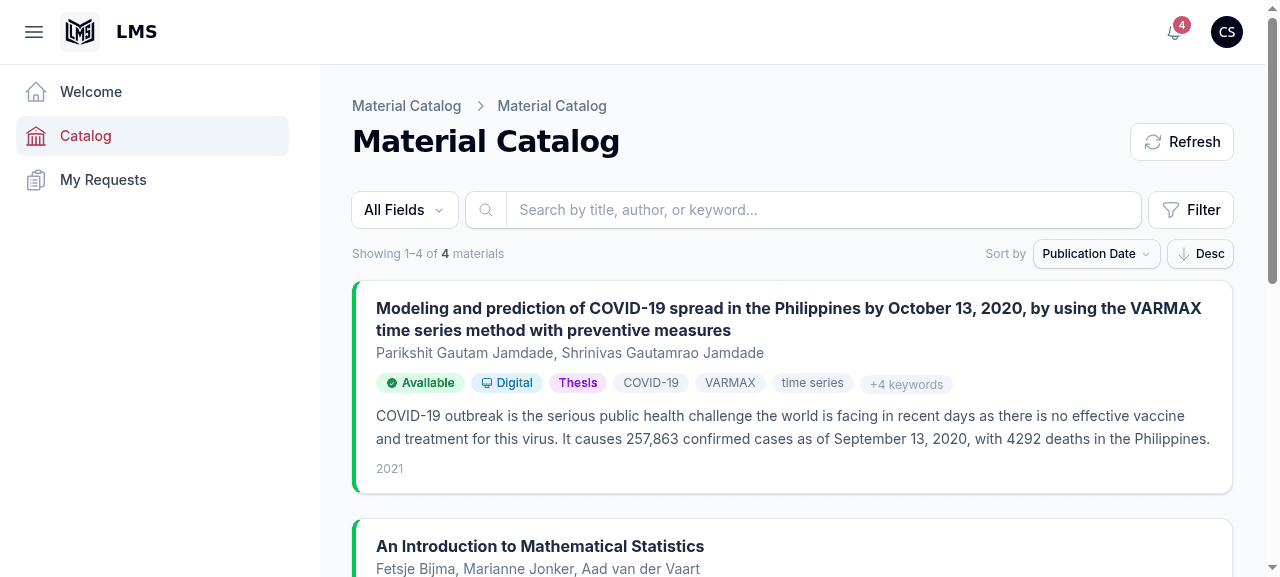
Catalog search, filters, availability, activity trends, and system-usage views help staff operate the collection deliberately.
Screenshot 1 / 2 Role-filtered catalog discovery
Engineering notes
Problem
Approved materials must be accessible remotely without treating a browser link as unrestricted distribution.
Approach
Authorized viewer and stream routes validate active approval before delivery. Protected PDFs are kept in private object storage and normalized with a user-and-time-specific QR watermark.
Rationale
A delivery control cannot prevent every capture method, but it adds traceability while preserving a practical reading experience.
Problem
A material’s visibility and request eligibility change with access level, availability, and a user’s existing request state.
Approach
The catalog and access workflow model roles, per-material access levels, request transitions, expiry, and notifications as first-class rules.
Problem
A deployable demonstration should prove real behavior without exposing production data or credentials.
Approach
The native Laravel application runs conventionally on Render with Supabase PostgreSQL and private object storage, using the canonical seeders and controlled shared-demo lifecycle.
Architecture
Students, faculty, and staff
Laravel 12 / Filament 5 workflows
Access requests and audit events
Supabase PostgreSQL and private storage
Embedding depends on the project host's security policy. The external site remains the reliable preview.
Live preview unavailable in embedded mode.
Open live application